
|
|
 |
| Home | Dog Profiles | More Photos | Articles | Available | Policies & Procedures | FAQs | Contact |
|
|
Dog Profile:
Massive Mugsy
|
|
Introduction: This is a Blasco Family Bulldogs© dog profile, introducing and profiling a dog that we do not own or keep on our yards, but have been privileged to use as a stud dog. We're proud of Mugsy, we're very pleased to have a sampling of his genes folded into our bloodlines, and I'm going to tell you about him. However, this is also an article that says some unfortunate things about the Dogue de Bordeaux breed overall, a breed that is in trouble, disease running rampant in Dogues throughout the world. It is my intention that the reader will understand clearly, and in no way confuse Mugsy with his sickly cousins. The reason we used Mugsy, was that he is a beautiful, vibrant, and a most excellent representative of the Dogue de Bordeaux breed. He is an example whose qualities should be strived for by other breeders, and whose blood should be highly valued. Mugsy is a Dogue who is very much a rare exception to the rule, who could in fact be utilized in efforts to repair the breed - though he is a traditional ranch dog, never having attended a single dog show. |
 |
|
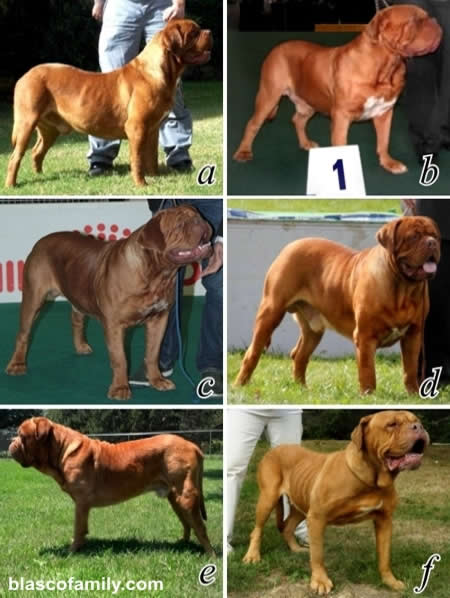
I have called Mugsy "atypical," making a distinction between Mugsy, and most other Dogue de Bordeaux. Glance left at what is typical of the modern day Dogue de Bordeaux. Note: The dogs to the left are NOT Mugsy. Let's do an informal evaluation of just the obvious stuff the pictures show us. Dogue a: Swayback, straight hock and stifle, questionable elbow. Dogue b: Straight hock and stifle, likely bandy-legged, at least one fallen pastern. Dogue c: Straight hocks and stifle. Dogue d: Straight hocks and stifle, ascending topline. Dogue e: Straight hock and stifle, ascending topline, out-of-balance. Dogue f: Bandy-legged (and what's wrong with that poor dog's rear end?!), front legs out to the side rather than under the shoulder, at least one out-turned elbow, a front foot facing the wrong direction, emaciated.
Ready for this...? Included in this group of structurally crippled genetic misfits are two US Champions, a Slavokian Champion, an Australian Champion, a French Champion, and an Argentinian Grand Champion (1). These are dogs considered to be the best representatives of the Dogue de Bordeaux breed. On my yards, some of them would have been euthanized to end their suffering, certainly none of them would ever be bred. These dogs could never hope to run properly, and given that every one of them has serious structural faults in the rear legs, it stands to reason (and the odds are very high) there's going to be some loose hip joints too; i.e., hip dysplasia (2). |
|
|
|
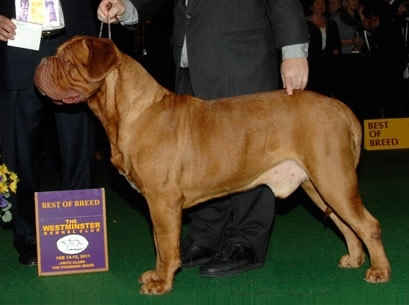
Are all Bordeaux like that? No. Here is Grand Champion Mount Sinai's Crusader St. Amand, winning Best of Breed at Westminister, February 2011 (3). However, most people will never own one of his puppies. Crusader is owned by responsible breeders (Mount Sinai Kennels), his genes not being cast across the planet thousands of puppies at a time. It is a demonstrated fact that dog show judges consistently let structural faults like those shown above slide, giving a dog points for his giant head, when he can barely gimp and gasp into the show ring. It is a testament both to the horrible state-of-the-breed overall, and to the abject harm dog show breeding commonly does to otherwise fine breeds of dogs. After all, once the judges confer the last points necessary for Champion status upon one of the crippled mutants we've evaluated above, it is then a valuable and sought after breeder. They are bred over and over again, throwing the genes of similarly crippled dogs into their progeny. As a result, the incidence of sickness and disease is multiplied exponentially. Puppies of "Champions" are sold throughout the world - made Champions by dog show judges, too ignorant of good dog structure to know a poor quality dog when they see one, or maybe just judging their friend's dog at a half dozen local shows, with only five dogs attending, all having been bred by the same friend. The dog show judge is supposed to be the last line of defense for a breed of dogs, identifying and ordering dogs out of the ring with structural failings. You only need to glance at the six registered Champions first reviewed above to know that's a bunch of hogwash, and that the marketing of many pedigreed dogs is no more than a scam. Now here you are, Joe or Jane Consumer, looking at the handsome pedigree of your $2,000.00 to $5,000.00 dog with all the CH designations before its ancestor's names (denoting a Champion bloodline). Yet you are confused... why can't your dog run well enough to fetch a tennis ball...? Why is your vet recommending Glucosomine and an aspirin a day at only three years of age...? These are the typical Dogue de Bordeaux: Diseased, handicapped, and bearing little resemblance to the multipurpose farm and guard dog they once were. |
|
|
|
Here, I'll back that up right now. Below, the Dogue de Bordeaux from 1749 to 1954. While there is a clear progression always headed further and further towards a less athletic, less fit dogue, all are well balanced, and until the 1954 dogue, lacking in grotesque exaggerations. Up until the 1954 dogue, all clearly possess the physical characteristics of working, or sporting dogs, capable of running. In the 1900s winning a dog show was more than a yuppie status symbol. We were still a primarily agrarian society back then. It was common that the common man knew the difference between a good dog and not-so-good dog, and he wasn't going to be fooled by a piece of paper bearing a kennel club's logo that said differently.
|
|
|
|
MASSIVE
MUGSY
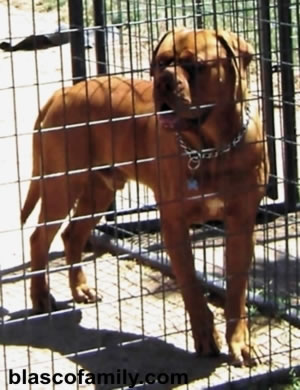
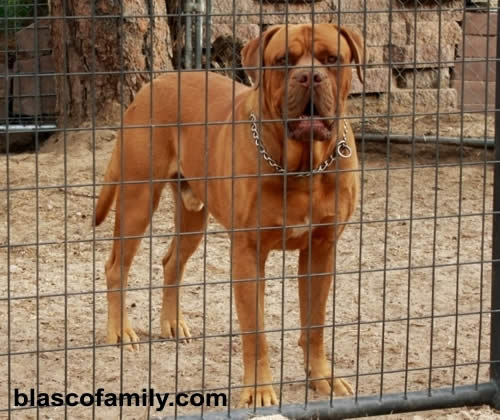
Look at Mugsy compared to the 1901 to 1933 dogues above. Owned by Dogue de Bordeaux breeders, Jim and Kathy Moos, Mugsy is truly an atypical Dogue de Bordeaux, a genetic throwback to dogues of the 1900s. Let's list some of the attributes that make Mugsy so special... All feet face forward, pasterns straight and solid. Good uniform angulation of the hock and stifles. Topline straight. Square, symmetrical but not overly elongated lines of a true running dog. Proper brachycephalic head, but not exaggerated and drooping, instead, well muscled and in balance with the rest of the dog. Mugsy is an excellent example of what the Dogue de Bordeaux should be, once was, and would be if other Dogue breeders understood and maintained the same high structural standards for their dogs as Jim and Kathy Moos. You can email Jim and Kathy at: moose820@gmail.com |
|
|
|
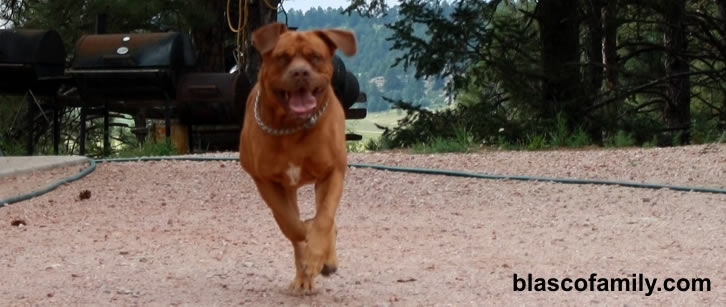
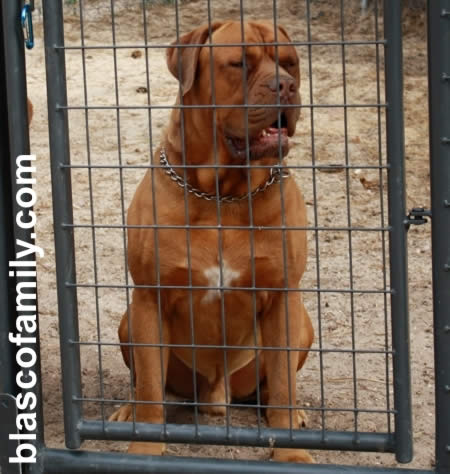
Here's a shot of Mugsy as an adult, thoroughly filled out. He's a powerhouse of a dogue. And look at that beautiful head - big, strong, highly substantial, but in no way grotesque or exaggerated - and he's got enough nose to actually be able to breath and have good olfactory. Mugsy is a proper Dogue de Bordeaux, thick, massive, overwhelming, but also well knit, in balance, healthy and a capable worker. Unlike the larger majority of Champion Dogue de Bordeaux, Mugsy is not some big, fleshy conversation piece gimping and gasping around the house, but a dog who runs a 40 acre Colorado ranch. |
|
|
|
Mugsy is the whole package too, capable, but in no way overly aggressive, the temperament of a gentle giant - friendly towards family and friends, distrustful, but not overtly aggressive towards strangers, a ferocious but stable-minded and well controlled watch dog. Here Mugsy wants to play daddy-dog to this pair of fat little English Bulldog puppies. Mugsy gets along well with other dogs, including other male dogs, though Mugsy does maintain certain social standards, and does not prefer the company of cats - though he has never actually tasted one... yet... |
|
|
|
At 6 1/2 years old, Mugsy is 30" tall at the shoulders, weighs 135 pounds in lean muscled, running shape, and has a 26" diameter head. Mugsy is a farm dog, easily running and jumping full speed ahead across acres of broken terrain. He has excellent structure and health - not a weak, loose or out-of-place bone or joint in his body. He has never been sick a day in his life, and tolerates extreme cold and heat equally well. Mugsy is an atypical and exemplary specimen of what a Dogue de Bordeaux should be: Hard, fearless, capable, and highly active and athletic. |
|
|
|
Massive Mugsy in Summary Massive Mugsy is a big, happy, well loved running dog, easily traversing acres at a time over rough, rocky, hilly terrain, just as the Dogue de Bordeaux was originally developed to do. He is healthy as a horse, free of disease, dramatically athletic, has excellent temperament, and the majority of Champion and Grand Champion Dogue de Bordeaux throughout the entire world cannot begin to compare to Mugsy's whole package fundamentals as a highly athletic and active ranch dog. Even the 2011 Westminister winner, Champion Mount Sinai's Crusader St. Amand featured above, as legitimately beautiful a dogue as he is, he still nonetheless lacks (as you can see for yourself) Mugsy's remarkable physique, and he is in fact a significantly smaller dog - show bred perhaps, rather than ranch bred. So then, now you understand why we bred Mugsy to our own Blasco's Kay Bella of A&B, to get their excellent F1 hybrid offspring, Blasco's Batman Bordeaux, and Blasco's Red Rena Bordeaux. Mugsy's characteristics and blood are an excellent addition to any line of working Mastiff dogs, and Dogue de Bordeaux breeders would be wise to seek Mugsy and his progeny as dams and sires in their own programs. You may contact his owners, Jim and Kathy Moos by email here: moose820@gmail.com
Massive Mugsy, AKC# WS26283401; UKC# P560-176; Jim and Kathy Moos: moose820@gmail.com |
|
Footnotes: (1) If you are the owner of one of the Dogue de Bordeaux Champions or Grand Champions pictured above, be advised, the photo of your dog was sourced in the public domain, already in free usage throughout the world, and not on, or linked to your own websites or kennel clubs. No permission for usage was therefore lawfully required. Further, all photos of poor quality dogs have been carefully cropped and digitally adjusted in order to not identify the dogs featured, a fully unnecessary action, performed specifically as a courtesy, to protect your reputations, and that of your kennel and dogs. (2) According to the Hip Dysplasia Statistics provided by the Orthopedic Foundation for Animals (OFA), of all dog breeds ever tested, the Dogue de Bordeaux ranks third highest worldwide for risk of hip dysplasia, with 60.2% of all Dogue de Bordeaux ever tested having been found to actually be dysplastic, and only 1.2% having ever received a score of "Excellent" out of every Dogue de Bordeaux ever tested. Similarly though not quite as statistically alarming, the Dogue de Bordeaux ranks 10th highest risk breed in Elbow Dysplasia Statistics out of 109 breeds tested, with more than a 20% likelihood of actual dysplastic elbows. The breed is further 36th highest risk for cardiac issues in the OFA's Cardiac Statistics, out of 121 different breeds tested. (3) You may view a record of Crusader's win at Westminister here: Dog News, GCH Mount Sinai's Crusader St. Amand. Crusader is owned by Mount Sinai Kennels, owned and operated by Paula Duvall, Melbourne, Kentucky, web address: http://mountsinaikennel.com/ They have an excellent breeding program, regularly producing excellent dogs, and Crusader is not their only Champion. However, even on the Mount Sinai Kennel website, demonstrating good ethics and candor they acknowledge, "The Bordeaux gene pool is small and there are several health issues. We wish we could say that all our breeding stock has passed every test, but they have not." |
| Home | Dog Profiles | More Photos | Articles | Available | Policies & Procedures | FAQs | Contact |
|
|
Breeding
dogs from a diversity of registered bloodlines -
It's
better for the dogs - it's better for the breed...







Ethical
Dog
Breeder
Award
Home | Available | Policies & Procedures | FAQs | Contact
Doc | Lilly | Nacho | Bella | Cherry | Mambo | Pete | Gypsy | Georgia | Saiga | Mikie | Judah | Batman | Rena | Uno


 Yes,
it's the breeders' and kennel clubs' fault, but first and foremost,
it's the dog show judges' fault...
Yes,
it's the breeders' and kennel clubs' fault, but first and foremost,
it's the dog show judges' fault...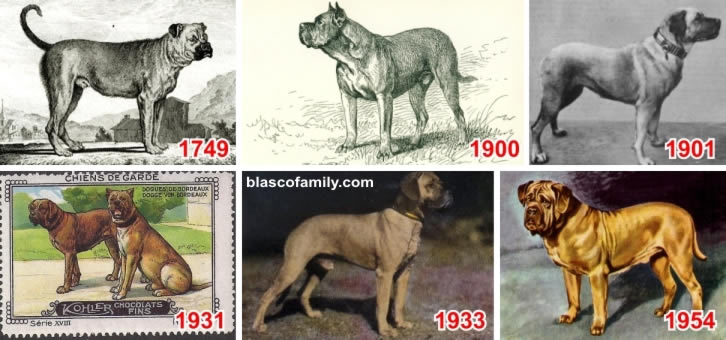

 Stats
for Massive Mugsy
Stats
for Massive Mugsy